
The Short Answer: Stable Device Capacity Matters More Than Port Count
A common online answer is that the USB protocol theoretically supports 127 addresses, allowing one host controller to connect up to 127 devices. That limit is defined at the protocol level in the USB 2.0 specification.
But when more than one hundred devices are connected to a single computer, the protocol specification does not answer the practical question: the computer may detect the devices, but the system may not run reliably.
Real-World Problems
Disconnections, insufficient power, a device dropping as soon as one port is used, or the computer failing to recognize devices after the fortieth connection are not necessarily signs that the protocol limit has been exceeded. They are physical-layer and system-architecture problems.
- Is enough current available per port?
- Is there sufficient total power headroom?
- How is bandwidth divided among host controllers?
- Can one faulty device bring down the entire USB bus?
Our Simple Rule
USB port count = product specification
Stable USB connectivity = real product capability
Real Device Counts in Industrial Applications
In mobile phone refurbishment, consumer electronics production-line testing, body-worn camera data collection, and IT asset disposition (ITAD), one computer commonly manages dozens or even hundreds of mobile devices at the same time:
Important Clarification
These high-density USB hubs are primarily designed for data communication and quality-control management - reading device status, transferring data, and verifying pass or fail results. Connected devices typically draw 200-300 mA, while each port is designed for a theoretical maximum of 500 mA. They are not intended for high-power charging. The real engineering challenge is supporting 24/7 operation, independent overcurrent protection per port, metal shielding against electromagnetic interference, and the mechanical durability required for repeated plugging and unplugging.
Four High Density Industrial USB Hub Examples
Sipolar has developed industrial-grade USB hubs since 2010. High port density has always been one of the most demanding parts of our product line. The four systems below range from workstation-level to full-production-line deployments and cover 32, 64, 96, and 192 USB ports.
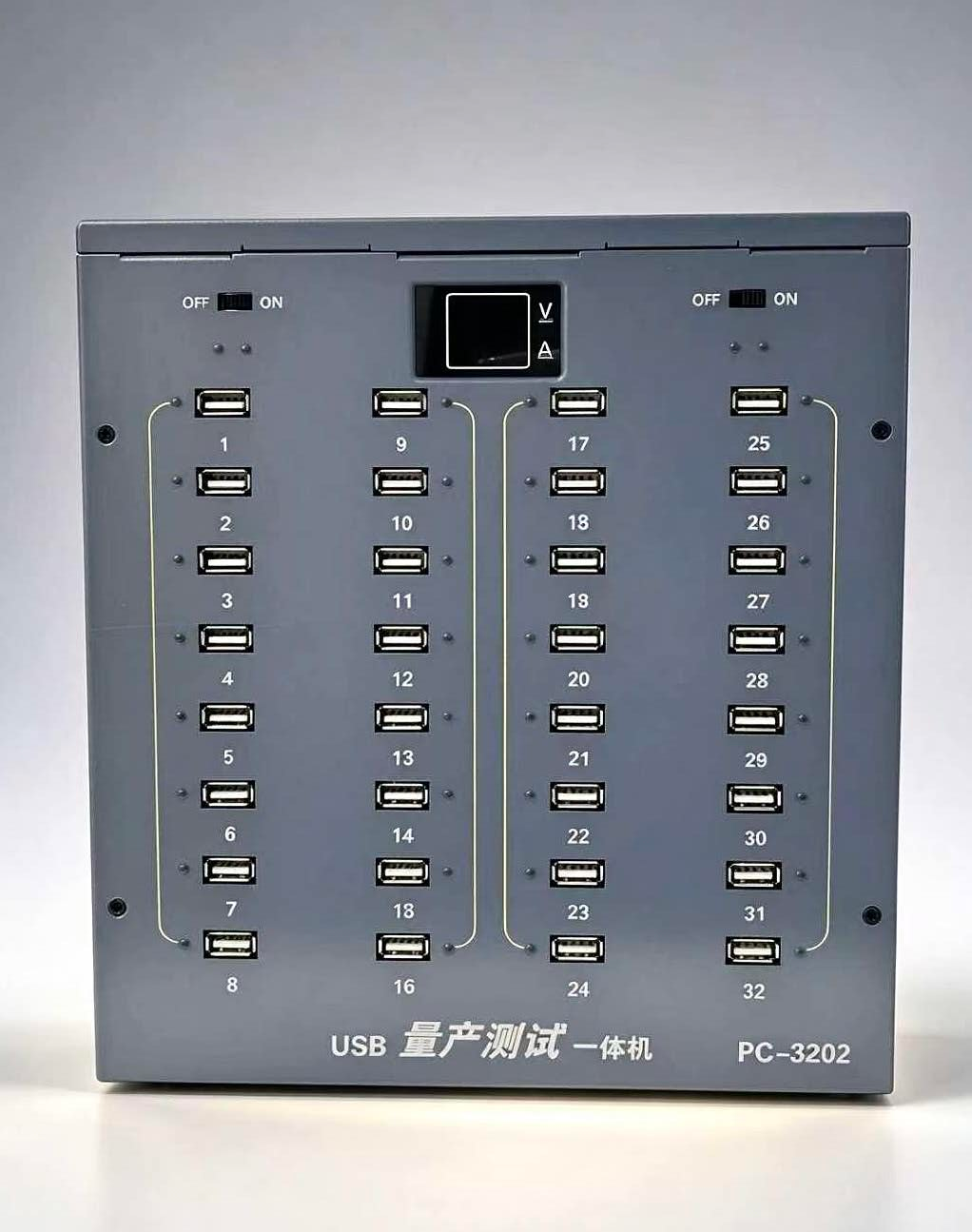
USB Production Test System
MODEL PC-3202 | 32 PORTS
Four independently switched power zones provide segmented control, while the front panel displays voltage and current. Each port is designed for a theoretical maximum of 500 mA for data communication and quality-control applications. Independent zones prevent a fault on one port group from affecting the others, allowing testing and device flashing to run in parallel.
- 4 independent power zones
- Front panel V/A display
- 500mA per port
Applications:
- Single-workstation batch functional testing
- Small-batch mobile phone flashing
- Batch USB drive and TF card testing
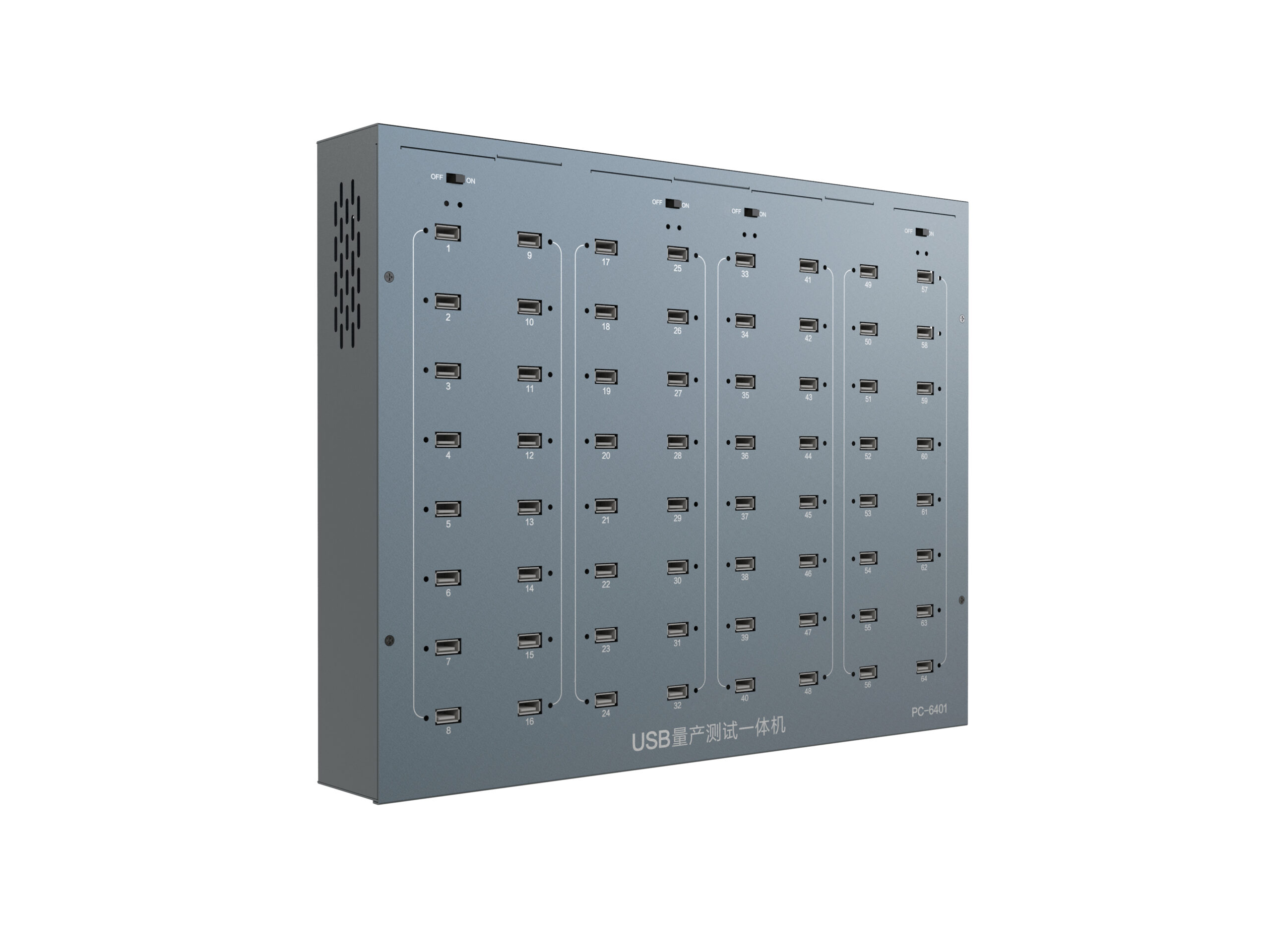
USB Production Test System
MODEL PC-6401 | 64 PORTS
An eight-column layout divides 64 ports into eight independently controlled groups, each with its own switch and status indicator. Each port is designed for 500 mA. The system supports batch device data communication and quality-control management and is suitable for shared use across multiple workstations on medium-sized production lines.
- 8 independent groups
- Per-group status indicators
- Multi-workstation sharing
Applications:
- Shared use across multiple production workstations
- Batch data acquisition
- Primary system for medium-sized refurbishment lines
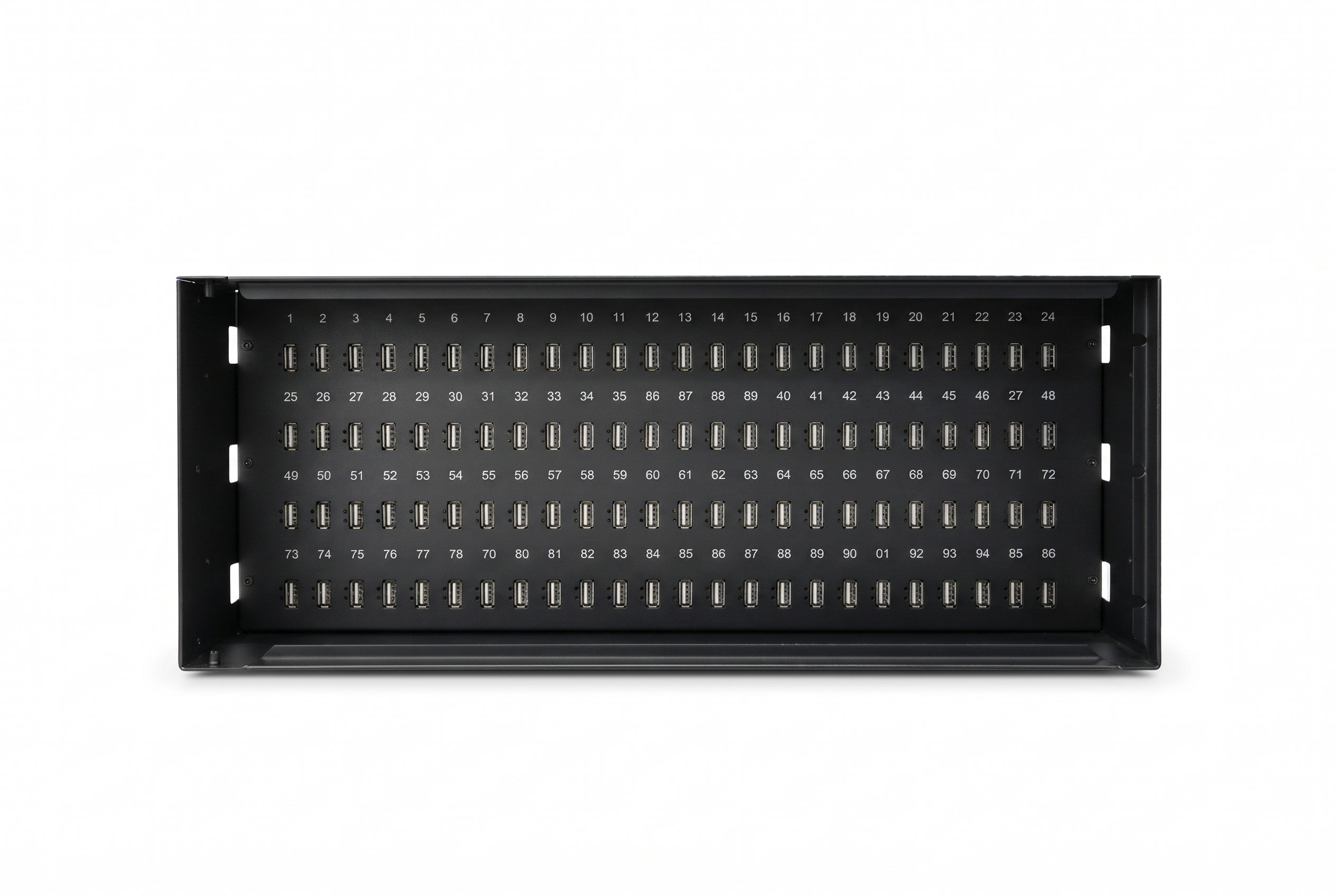
Rackmount High Density USB Hub
MODEL SH-96 | 96 PORTS
This 96-port rackmount USB hub uses a metal enclosure for EMI shielding and is designed for long-term continuous operation. It is intended for high-volume device data communication and quality-control management rather than high-power charging.
- Metal EMI shielding
- Rackmount design
- 24/7 continuous operation
Applications:
- Centralized device management
- High-volume data erasure and ITAD
- Body-worn camera data collection
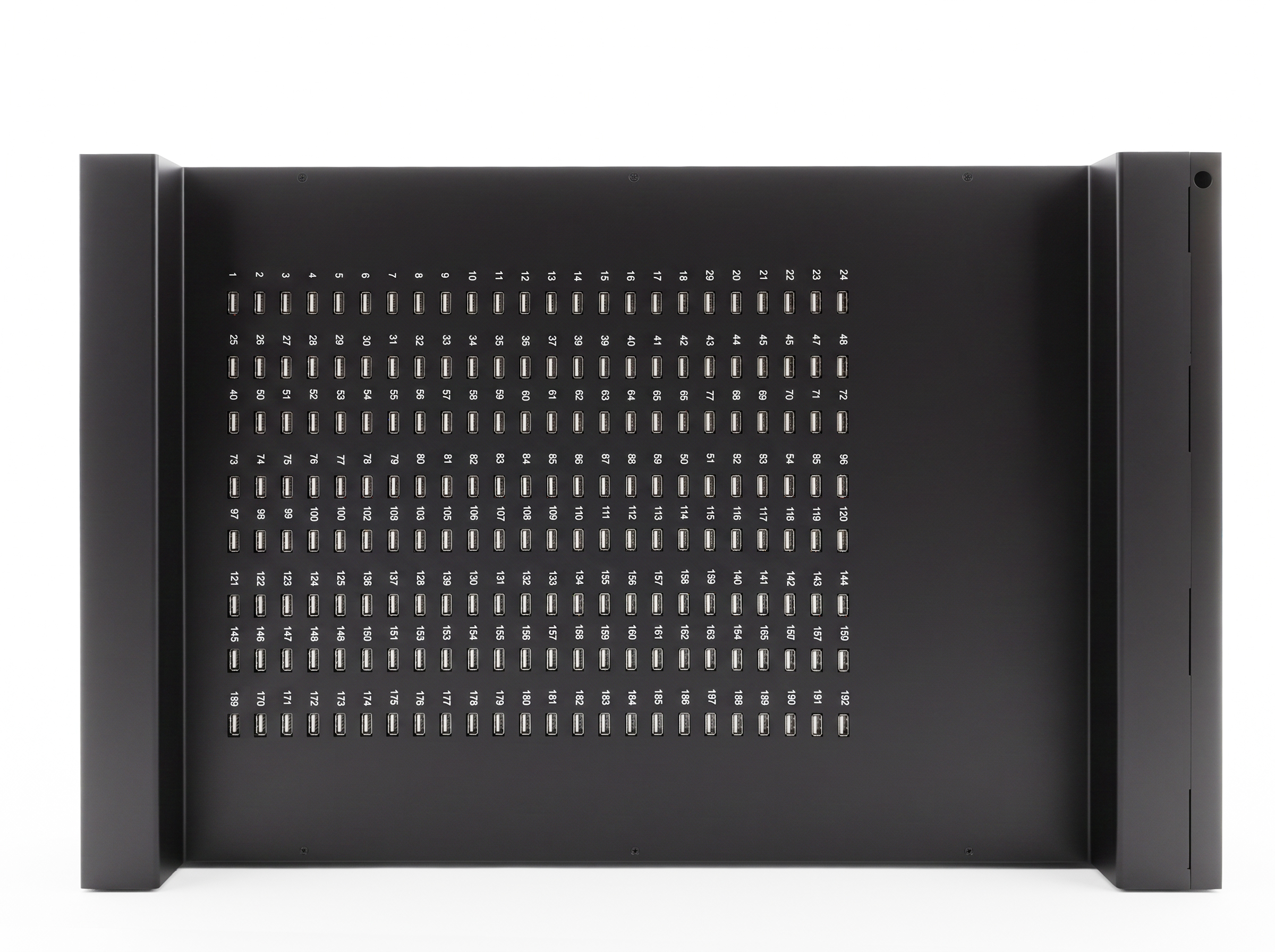
Dual Channel ESH Rackmount USB Hub
MODEL SH-192 | 192 PORTS
The system provides 192 USB-A ports with a dual-channel ESH architecture. Each independent channel manages half of the connected devices, so a problem on one channel does not bring down the other. Each port is designed for 500 mA. The system supports high-density data communication and quality-control management, allowing 96 devices to be flashed on one channel while 96 devices are erased on the other without interference.
- Dual-channel architecture
- Independent channel isolation
- Parallel operation capability
Applications:
- Centralized access for an entire production line
- Large mobile device refurbishment factories
- Data-center-style device management
Why High Port Counts Are Difficult to Engineer
Building a 192-port USB hub is not simply a matter of soldering 160 more connectors than a 32-port model. The engineering challenge is concentrated in four areas:
Power Distribution
These four systems are designed for data communication and quality-control management, with a theoretical limit of 500 mA per port and typical connected-device current of 200-300 mA. Even so, a fully loaded 192-port system approaches 100 amps of total current at 5V.
Multi-rail power distribution, per-port overcurrent isolation, and bus voltage-drop compensation must all work correctly. Otherwise, the first devices may run normally while later devices begin disconnecting.
Host Controllers and Bandwidth
USB host controllers have limited endpoint resources. As port density increases, devices must be distributed across multiple controllers so congestion on one path does not affect the entire system.
This is an architecture problem, not a specification-sheet problem.
Thermal Management and Mechanical Design
High port density increases heat generation per unit volume. The metal enclosure, internal airflow, and temperature control under sustained full load determine whether the system can operate reliably 24/7.
Serviceability
If one port fails, can the problem be isolated and repaired, or must the entire system be returned? One hour of production-line downtime may cost more than the hub itself.
High-density models therefore use grouped switches and port-level status indicators to help maintenance teams locate faults quickly.
Sipolar Is More Than an Industrial USB Hub Manufacturer
This distinction matters because it defines how we approach each application.
A product catalog would describe Sipolar as an industrial USB hub manufacturer. The product line covers 4 to 192 ports across USB 2.0, USB 3.0, and USB Type-C PD, including standard products and OEM/ODM customization.
Customers usually contact us because they face a specific connectivity problem, not because they simply want to buy a USB hub:
Common Scenarios
"Forty mobile phones are flashed simultaneously on the production line, but several always disconnect. We tried three hub brands and the problem remained."
"The USB hub is installed inside a self-service terminal. The cabinet reaches 50°C in summer, and the hub does not survive the season."
"Our robot connects to eight peripherals near a variable-frequency drive, and data errors keep occurring."
Our Positioning
These are not problems that can be solved by buying another product. They require an engineered solution that makes USB connectivity reliable. So we define Sipolar as an industrial USB connectivity solution provider. Selling hardware is the outcome; the real task is determining which devices must connect, in what environment, and at what reliability level.
From Detecting Devices to Running Them Reliably
Returning to the original question: how many USB ports can one computer support?
- At the protocol level: 127 is the address limit
- At the product level: Sipolar's dual-channel architecture supports 192 ports
- At the application level: How many devices can run reliably in your specific application?
There is no universal answer. It depends on device type, power requirements, operating time, ambient temperature, and interference sources.
Five Questions Before Recommending
1. How many devices will be connected?
2. Must the system run 24/7?
3. Are there interference sources nearby?
4. Is per-port control required?
5. How much cabinet space is available?
Once these five questions are answered, the appropriate architecture and model are usually clear.
About Sipolar
Shenzhen Lpsen Technology Co., Ltd. was founded in 2010 and is recognized as a National High-Tech Enterprise and a Guangdong Specialized, Refined, Distinctive, and Innovative SME. Its Sipolar brand focuses on industrial USB hubs from 4 to 192 ports, serving customers in self-service terminals, data centers, industrial control, mobile phone refurbishment, and ITAD across more than 100 countries.
We have spent 16 years solving industrial connectivity problems.
For a model recommendation, provide three details: the number of connected devices, required operating time, and installation environment. Sipolar can then recommend the appropriate industrial USB hub configuration.