Latest News & Insights

What Is a 9‑24V Wide‑Voltage Hub and Why Is It Essential

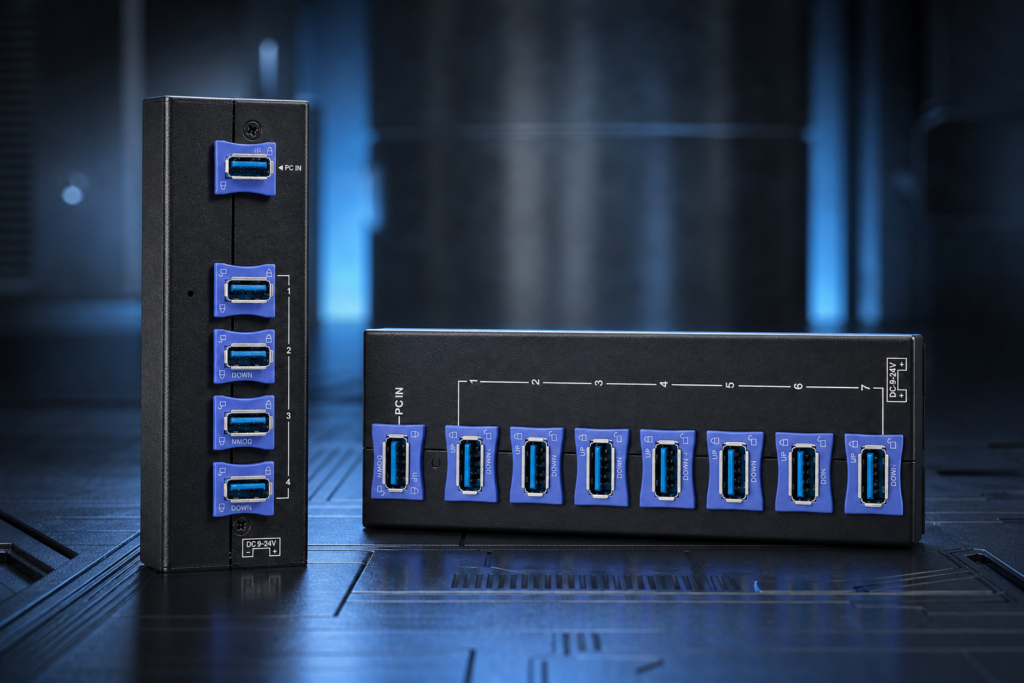
In automation equipment, control cabinets, AGVs, CNC machines, and inspection systems, the supply voltage is often not the standard 5V – 12V or 24V DC buses are the norm. Consumer‑grade USB hubs are designed for 5V only; in these scenarios they either cannot be powered at all, or they force you to add a DC‑DC step‑down converter – adding cost, reducing reliability, and wasting valuable space. That’s exactly why the Sipolar AT‑4U30M2 (4‑port USB 3.0 hub) and AT‑7A30M1 (7‑port USB 3.0 hub) were created: to connect directly to the native power supply on the factory floor, plug‑and‑play, stable, and dropout‑free. 1. What Is Wide‑Voltage Input, and How Is It Different from Ordinary Hubs? Typical consumer USB hubs use one of these power schemes: Bus‑powered hubs: draw 5V/500mA from the computer’s USB port – insufficient for power‑hungry devices. Self‑powered consumer hubs: use an external 5V/2A~5V/5A adapter – but still support only a single fixed voltage. A 9‑24V wide‑voltage hub, on the other hand, integrates a built‑in DC‑DC buck converter that automatically regulates any input between 9V and 24V down to a stable 5V output for the USB ports. This delivers three clear benefits: 1.Extreme compatibility – directly tap into 12V or 24V industrial power supplies without an extra adapter. 2.High tolerance to voltage fluctuations – industrial power can be noisy; the wide‑range design handles ±20% or more variation with ease. 3.Reduced clutter – eliminate separate DC‑DC modules, freeing up cabinet space and simplifying cabling. 2. Anti‑Loosening Design: No More Glue – A Blue Clip Does the Job Beyond wide‑voltage input, these two products also feature a critical keyword: “anti‑loosening”. In automated equipment, vibration, movement, robotic arm action, and AGV travel are everyday realities. Ordinary USB plugs easily work loose, make poor contact, and drop out under such conditions. Many engineers used to resort to gluing the USB plugs in place – effective against loosening, but a nightmare for maintenance, damaging both ports and cables. The AT‑4U30M2 and AT‑7A30M1 include a built‑in blue locking clip inside every USB‑A port. It’s incredibly straightforward: 1.Insert the USB cable normally. 2.Flip the blue clip upward – it automatically engages with the metal shell of the USB plug. 3.The cable is now mechanically locked – no glue, no extra parts. To release, simply press the clip back down and pull the cable out – reusable indefinitely. The benefits are obvious: No glue – save time and material costs; faster assembly. Serviceable – unplugging for maintenance or upgrades is quick, no scraping off adhesive. Vibration‑proof – the mechanical lock stays secure even under shaking or tension. Cable‑friendly – unlike zip ties or screws, it doesn’t crush or damage the cable insulation. In short: what used to be a makeshift glue fix is now an industrial‑grade, professional solution – the blue clip. 3. Power Interface Details: How Do You Connect 9‑24V Wide Voltage? The side of the hub features a standard DC power jack, clearly marked with “DC 9‑24V” silk‑screening for easy identification on site. Connection options are flexible: Control cabinet with a 12V DC bus → plug it in directly. On‑site 24V switch‑mode power supply → plug it in directly. Vehicle/AGV systems (typically 12~19V) → plug it in directly. No need to buy a separate 5V adapter, and no worries about connecting the wrong voltage – anything within the wide range works safely. Inside, the power management IC includes overcurrent protection, short‑circuit protection, and reverse‑polarity protection, so even if you reverse the positive and negative leads, the hub won’t burn out – giving maintenance teams peace of mind. 4. Which One to Choose? It Depends on How Many Devices You Need to Connect AT‑4U30M2 – 4‑Port USB 3.0 Hub Ports: 4 USB‑A 3.0 ports, each with a blue anti‑loosening clip. Voltage: 9‑24V wide input. Best for: Small‑scale industrial controls, robot end‑effectors, inspection instruments, AGV navigation modules. Advantage: Compact size, friendly for space‑constrained cabinets. AT‑7A30M1 – 7‑Port USB 3.0 Hub Ports: 7 USB‑A 3.0 ports, each with a blue anti‑loosening clip. Voltage: 9‑24V wide input. Best for: Medium to large automation lines, multi‑sensor data acquisition, multi‑camera vision systems. Advantage: Handles up to 7 devices in one hub, reducing signal degradation from daisy‑chaining multiple hubs. Selection logic is simple: 4 or fewer USB devices → AT‑4U30M2. 5 to 7 USB devices → AT‑7A30M1. More than 7 → consider a 10‑port+ industrial hub. 5. Typical Applications: These Industries Are Using Wide‑Voltage + Anti‑Loosening Hubs 1.Automation production lines Connect industrial cameras, barcode scanners, fingerprint sensors, and PLC debug ports for centralised data collection. 2.AGVs / mobile robots Powered directly from the vehicle’s 12V/24V system, with locking clips to withstand movement and vibration. 3.CNC machine tools Draw 24V from the machine control cabinet, expand USB probes, gauges, and data feedback devices. 4.Medical diagnostic equipment Endoscopes, biochemical analysers, imaging devices that require stable USB expansion. 5.Military & special‑purpose equipment Wide‑voltage compatibility with multiple power systems, and anti‑loosening for harsh environments. 6.AOI optical inspection machines Multiple cameras connected simultaneously, needing strong power delivery and stable channels. 7.Laboratory & research setups Data acquisition cards and sensor arrays running continuously over long periods. 6. Q&A – Frequently Asked Questions Q: What does a 9‑24V wide‑voltage hub mean? A: It means the hub accepts any DC input from 9V to 24V, allowing direct connection to industrial 12V/24V power supplies without an extra DC‑DC converter. Q: What is the purpose of an anti‑loosening USB hub? A: Each USB port has a built‑in blue clip. After inserting the cable, flip the clip up to mechanically lock the plug – eliminating the need for glue and preventing disconnections caused by vibration. Q: Can the locking clip be reused? A: Yes. The blue clip supports unlimited cycles of locking and releasing without affecting port life, making maintenance and cable swaps easy. Q: What’s the difference between the AT‑4U30M2 and AT‑7A30M1? A: The key difference is the number of ports – 4 for small setups, 7 for medium‑to‑large multi‑device scenarios. All other features are identical. Q: Can a wide‑voltage hub be powered by a standard 5V supply? A: No. The input range starts at 9V; supplying less than 9V will not allow normal operation. Always follow the marked voltage guidelines. Q: How do industrial USB hubs differ from consumer ones? A: Industrial hubs offer wide‑voltage input, anti‑loosening clips, independent channels, interference shielding, and industrial‑grade components – consumer hubs are only designed for desktop use. 7. Conclusion Back to the opening question: What does a 9‑24V wide‑voltage hub mean? In one sentence: It’s a USB expansion device purpose‑built for industrial 12V/24V power systems – connect directly to the native voltage, no more DC‑DC modules to fiddle with. Add the blue‑clip anti‑loosening design – plug in, flip, and lock – and you can finally say goodbye to glue‑based fixes. Stability far surpasses that of ordinary consumer hubs. The Sipolar AT‑4U30M2 (4‑port) and AT‑7A30M1 (7‑port) cover the vast majority of USB expansion needs in industrial automation, from small controls to large production lines – they are a go‑to choice for engineers building industrial USB integration solutions. How are you currently connecting USB devices in your automation setup? Have voltage mismatches or loose connectors ever caused you trouble? We’d love to hear your field experiences – feel free to reach out or leave a comment. For detailed specifications, application guides, and more, visit www.sipolar.com.

Read More »

Industrial Camera & USB Hub: A Complete Guide to Sipolar Models

In modern automation systems, cameras and sensors play a critical role in data acquisition and quality monitoring. With numerous devices generating massive data streams, USB hubs must deliver exceptional stability, high transfer performance, and strong interference immunity. The Sipolar 4U30 (4‑port USB 3.0), A‑173 (7‑port USB 3.0), and A‑103 (10‑port USB 3.0) hubs are all engineered with industrial‑grade independent power supplies and robust anti‑interference capabilities, making them ideal choices for automated camera applications. This article provides a systematic analysis of these three hub models, their features, and their best‑fit scenarios to help you make an informed decision. 1. Three Essential Advantages of Industrial‑Grade Hubs High‑Power Independent Power Supply All three Sipolar industrial hubs feature a dedicated power supply design, ensuring each port and connected device receives stable, sufficient current. This eliminates device dropouts or reboots caused by insufficient power, meeting the demands of continuous full‑load industrial operation. Strong Anti‑Interference Capability To cope with electromagnetic interference and signal jitter in complex industrial environments, these hubs incorporate effective shielding structures and filtering chips. This significantly improves signal quality, ensuring that camera and sensor data are transmitted accurately and reliably. Stable High‑Speed Transmission Based on the USB 3.0 protocol, all three hubs support data transfer rates up to 5 Gbps, guaranteeing real‑time transmission of high‑definition video streams and large‑volume sensor data – exactly what multi‑device automation scenarios require. 2. Product Details and Selection Guide Sipolar 4U30 – 4‑Port USB 3.0 Hub Ports: 4 x USB 3.0 – suitable for small to medium‑sized automation sites Design: Aluminum alloy housing for durability and excellent heat dissipation Best for: Connecting basic cameras and a few sensors – an ideal space‑saving solution Sipolar A‑173 – 7‑Port USB 3.0 Hub Ports: 7 x USB 3.0 – greater expansion capacity Design: Industrial aluminum shell with upgraded interference protection Best for: Medium to large automation systems with multiple cameras and various sensors Sipolar A‑103 – 10‑Port USB 3.0 Hub Ports: 10 x USB 3.0 – designed for large‑scale industrial device connectivity Advantage: Advanced anti‑interference design and exceptional overall stability Best for: Large production lines and complex, high‑speed data acquisition environments 3. Real‑World Application Case Study One manufacturing enterprise deployed the Sipolar A‑103 hub to centrally manage dozens of cameras and fingerprint sensors. As a result, monthly device dropout failures dropped by 80%, data transmission became consistently error‑free, and maintenance time was significantly reduced. Meanwhile, smaller and mid‑sized plants have adopted the 4U30 and A‑173 models to flexibly accommodate changing device requirements, ensuring uninterrupted long‑term monitoring. 4. Professional Selection Tips Fewer devices, moderate power needs → Choose the 4U30 (4‑port) – compact, efficient, and space‑friendly. Medium‑scale deployment → The 7‑port A‑173 supports multiple cameras and sensors, with room for future expansion. High device density and big data demands → The 10‑port A‑103 offers robust anti‑interference and stable long‑distance high‑speed links. All models are built for continuous operation in industrial environments. Independent power supplies and multiple protection mechanisms are the keys to their reliability. Q: Why do industrial camera hubs require independent power? A: To prevent power conflicts between devices and ensure that multiple cameras and sensors run stably at the same time. 5. The Critical Role of Hubs in Smart Industry Cameras and sensors are the “eyes” and “ears” of industrial automation and digitalisation, while a stable, high‑speed hub serves as the data highway’s “intersection.” The Sipolar 4U30, A‑173, and A‑103 industrial‑grade USB 3.0 hubs offer professional, reliable connectivity solutions for different scales and needs, enabling more efficient automation equipment operation and more accurate data. Is your current hub capable of stably powering all your industrial cameras and sensors? Share your selection experience with us – we’d love to hear from you. For more product details and technical specifications, visit www.sipolar.com.

Read More »

Industrial-Grade vs. Consumer-Grade USB Hubs: What’s the Difference?

A Deep Dive into the Sipolar A-4A30M4 Aluminum 4-Port USB 3.0 Hub In automated equipment and harsh industrial environments, the stability and durability of a USB hub directly impact production efficiency. The Sipolar A-4A30M4, built with an aluminum alloy body and engineered for industrial scenarios, exemplifies the essential differences between industrial-grade and consumer-grade USB hubs. This article explores how this aluminum 4‑port USB 3.0 hub outperforms home‑use models in performance, construction, and longevity to meet the most demanding industrial requirements. Core Differences: Industrial vs. Consumer USB Hubs 1.Material: Aluminum for Durability and Heat Dissipation Consumer USB hubs are often made of plastic, which is prone to cracking and offers poor heat dissipation. The Sipolar A‑4A30M4 features a scratch‑resistant aluminum alloy shell that not only withstands tough conditions but also provides excellent thermal management, ensuring stable operation under high temperature and heavy loads. 2.Design & Workmanship: Built to Last The A‑4A30M4 sports a clean, rugged design with well‑spaced ports and gold‑plated metal connectors for enhanced signal integrity and longer service life. Its overall construction meets industrial standards, with vibration and electromagnetic interference resistance far superior to consumer‑grade products. 3.Power Supply & Stability: Independent Voltage Regulation Industrial‑grade hubs come with an external power adapter and built‑in voltage regulation chips, preventing device dropouts caused by current fluctuations. Consumer hubs typically draw power solely from the computer’s USB port, which often cannot supply enough current for multiple devices. Q&A: How does an aluminum housing affect USB hub performance? Aluminum not only increases mechanical strength but also significantly improves heat dissipation, preventing overheating that could compromise device stability. Two Sipolar Aluminum 4‑Port Hubs Compared Sipolar A‑4A30M4 (USB‑A 3.0) Aluminum body for superior protection and cooling Four USB 3.0 ports, up to 5 Gbps transfer speed Ideal for expanding industrial equipment – automation instruments, industrial printers, etc. Compact 4‑Port USB‑C 3.2 Model Minimalist aluminum design, square and portable USB 3.2 speeds up to 10 Gbps Perfect for high‑speed data acquisition, professional video capture Small footprint, easy to install in tight industrial spaces  Selection Guide: Which One Fits Your Industrial Environment? If you need stable power delivery to support multiple devices simultaneously, the A‑4A30M4 is the robust, reliable choice. For extreme transfer rates – large industrial data sets or high‑definition video – the USB‑C 3.2 model is your best bet. If space and aesthetics matter, the ultra‑compact USB‑C version can be easily hidden or mounted. Q&A: Can an industrial‑grade USB hub really boost productivity? By providing stable power and strong interference rejection, it reduces device disconnections and data packet loss, significantly cutting troubleshooting costs. Typical Applications & Customer Feedback An automation factory used the A‑4A30M4 to connect multiple industrial devices and saw device dropout rates drop by over 80%, greatly improving continuous assembly line efficiency. A video editing studio adopted the USB‑C 3.2 hub to ensure real‑time, low‑latency transmission of high‑resolution footage, meeting the demands of professional post‑production. Summary Aluminum construction, industrial‑grade design, and stable power delivery are the three pillars that set the Sipolar A‑4A30M4 and the USB‑C 3.2 hub apart in the industrial field. Choosing the right industrial‑grade USB hub is the key to ensuring long‑term, trouble‑free operation of your equipment. Is your production site experiencing issues due to inadequate hub performance? Feel free to reach out – let’s explore the best industrial connectivity solutions together.

Read More »

10-Port USB 3.0 Charging Hub: For High-Speed Data Sync and Charging

As USB-powered devices continue to dominate modern workplaces, laboratories, retail environments, and production lines, managing multiple devices efficiently has become increasingly important. Whether you’re charging tablets, synchronizing mobile devices, or connecting USB peripherals, a reliable multi-port USB hub can dramatically improve productivity. The Sipolar A-423 10-Port USB 3.0 Charging Hub is designed specifically for professional users who require stable power delivery, ultra-fast data transfer, and dependable performance in demanding environments. Why Businesses Need a Professional USB Charging Hub Traditional USB hubs often struggle when multiple high-power devices are connected simultaneously. Insufficient power supply, unstable data transmission, and overheating can interrupt workflows and reduce efficiency. The Sipolar A-423 eliminates these problems with a dedicated 120W (12V/10A) external power adapter, ensuring every connected device receives stable power while maintaining full USB 3.0 performance. Ideal for: Industrial automation Office workstations IT deployment Education environments Mobile device management POS systems Digital signage Repair centers Laboratories Gaming setups Charge and Sync Up to 10 Devices Simultaneously Unlike ordinary USB splitters, the A-423 supports both high-speed data synchronization and fast charging at the same time. Users can simultaneously connect: Tablets Smartphones External hard drives USB flash drives Barcode scanners Printers Cameras Keyboards Mouse devices Game controllers The hub supports synchronization software including iTunes and Apple Configurator, making it an excellent solution for schools, enterprises, and device deployment projects. USB 3.0 SuperSpeed Performance Every USB port supports USB 3.0 SuperSpeed technology with transfer speeds up to 5Gbps, approximately ten times faster than USB 2.0. Benefits include: Faster file transfers Reduced backup time Smooth HD video transmission Stable connection for external SSDs and HDDs Backward compatibility with USB 2.0 and USB 1.1 devices Whether transferring large multimedia files or connecting multiple peripherals, users experience consistent performance without bottlenecks. Stable 120W Power for High-Demand Devices One of the biggest advantages of the A-423 is its powerful independent power supply. The included 120W desktop power adapter provides sufficient current for connecting multiple high-power USB devices simultaneously. Each port delivers up to 5V/2.1A, making the hub suitable for charging tablets, smartphones, and other USB-powered equipment without sacrificing stability. No computer is required when charging devices. Industrial-Grade Safety Protection Reliability is essential in professional environments. The Sipolar A-423 incorporates multiple protection mechanisms including: Over-current protection Over-voltage protection Short-circuit protection Hot-plug support These built-in safeguards help protect both connected devices and the hub itself, ensuring long-term dependable operation. Durable Metal Housing for Continuous Operation Unlike plastic USB hubs, the A-423 features a robust metal enclosure designed for better heat dissipation and long service life. Its compact desktop design makes installation simple while maintaining excellent durability for continuous daily operation. Blue LED indicators provide clear visual confirmation of active USB ports, improving device management. Wide System Compatibility The A-423 is designed for true plug-and-play operation with no additional drivers required. Compatible operating systems include: Windows XP Windows Vista Windows 7 Windows 8 / 8.1 macOS Simply connect the hub and begin working immediately. Typical Applications The Sipolar A-423 is widely used across numerous industries, including: Tablet charging stations Mobile phone testing Device provisioning Classroom tablet management Healthcare equipment Factory automation Security monitoring systems Retail POS terminals Office expansion Engineering development Wherever multiple USB devices need reliable charging and data synchronization, the A-423 delivers professional-grade performance. Why Choose Sipolar? For years, Sipolar has specialized in designing and manufacturing professional USB hubs and charging stations for customers worldwide. Our products are trusted by businesses across industrial automation, education, healthcare, retail, and IT industries because they deliver: Industrial-quality manufacturing Stable performance High-speed USB connectivity Reliable power management International certifications (CE, FCC, RoHS) One-year warranty OEM & ODM customization services Whether you are an enterprise buyer, distributor, system integrator, or project contractor, Sipolar provides dependable USB connectivity solutions tailored to your business needs. Conclusion The Sipolar A-423 10-Port USB 3.0 Charging Hub combines high-speed data transfer, 120W stable power delivery, simultaneous charging, and industrial-grade reliability into one compact device. If your organization requires efficient management of multiple USB devices while maintaining exceptional stability and performance, the A-423 is an ideal solution. Looking for bulk orders or OEM/ODM customization? Contact Sipolar today to discover professional USB hub solutions built for your business.

Read More »

7-Port USB 3.0 Hub:For Device Management, Data Transfer, and Charging

In today’s digital workplace, businesses often need to connect and manage multiple USB devices simultaneously. Whether it’s a mobile phone testing station, a retail service center, a data collection environment, or a printing shop, stability and efficiency are critical. The SIPOLAR FS-801 7-Port USB 3.0 Hub is designed to meet these demands by combining high-speed data transfer, intelligent power management, and industrial-grade durability in a compact aluminum enclosure. High-Speed USB 3.0 Performance The FS-801 features seven USB 3.0 downstream ports and supports data transfer speeds of up to 5Gbps. This enables users to transfer large files, synchronize devices, and connect high-bandwidth peripherals without bottlenecks. Compared with traditional USB 2.0 hubs, the FS-801 delivers significantly faster performance for applications involving multiple storage devices, smartphones, scanners, cameras, and other USB equipment. Independent Switch Control for Better Efficiency One of the most practical features of the FS-801 is its independent switch design. Users can enable or disable connected devices individually without unplugging cables, reducing wear on USB connectors and improving operational convenience. This feature is particularly useful in: Mobile phone batch management Device testing laboratories Printing and copy centers POS systems Data acquisition stations USB-C Host Connection for Modern Devices The upstream USB-C interface provides broad compatibility with modern computers and workstations. The hub works seamlessly with: Windows 7/8/10/11 macOS 10.12 and above Linux Ubuntu 16.04 and above No additional drivers are required for most applications, enabling true plug-and-play operation. Fast Charging Support with BC1.2 Protocol Beyond data transmission, the FS-801 supports BC1.2 charging technology and provides up to 5V/2A output per port. This allows users to charge multiple smartphones, tablets, barcode scanners, and other USB-powered devices simultaneously while maintaining stable operation. For mobile device management environments, this significantly improves productivity and reduces charging downtime. Industrial-Grade Power Design Unlike many consumer-grade USB hubs, the FS-801 supports a wide DC 9V-24V input range, making it suitable for various industrial and commercial environments. Built-in protection functions include: Over-current protection Short-circuit protection These safeguards help protect connected devices and ensure long-term operational stability. Durable Aluminum Housing The hub is housed in a rugged aluminum enclosure that offers excellent heat dissipation and mechanical strength. The compact design makes it ideal for desktop deployment while maintaining durability in demanding working environments. Ideal Applications The SIPOLAR FS-801 is widely used in: Mobile phone control systems Device synchronization stations Repair and service centers Printing shops Industrial automation systems Data collection platforms Educational and laboratory environments Conclusion The SIPOLAR FS-801 7-Port USB 3.0 Hub combines fast data transfer, charging capability, industrial-grade reliability, and convenient independent port control in a compact solution. For businesses seeking a stable multi-device connectivity platform, the FS-801 provides an efficient and dependable choice that helps improve workflow productivity while protecting valuable equipment. Learn more about SIPOLAR industrial USB hubs and charging solutions by visiting www.sipolar.com.

Read More »

Simplify Bulk Device Charging with Sipolar Multi-Port USB-C Charging Stations

As businesses, schools, repair centers, and device management teams continue to deploy larger numbers of smartphones, tablets, barcode scanners, and other USB-powered devices, efficient charging solutions have become essential. Traditional chargers often create cable clutter, consume excessive power outlets, and make device management difficult. To address these challenges, Sipolar introduces two professional USB-C charging solutions designed for centralized charging and reliable operation: the C-165C 16-Port USB-C Charger and the C-402C 10-Port USB-C Charger. Why Multi-Port USB-C Charging Matters Modern organizations frequently need to charge dozens of devices simultaneously. Whether managing employee smartphones, classroom tablets, testing devices, or inventory scanners, centralized charging offers several advantages: Reduced cable and adapter clutter Better workspace organization Improved charging efficiency Lower equipment management costs Easier deployment and maintenance Sipolar’s charging stations provide a simple and scalable way to keep devices powered and ready for use. C-165C: High-Capacity 16-Port USB-C Charging Station The Sipolar C-165C is designed for environments where large numbers of devices require simultaneous charging. Key Features: 16 USB Type-C charging ports Up to 5V/2.1A output per port Total output power up to 200W Supports BC1.2, Apple, and Samsung charging protocols Built-in temperature-controlled cooling fan Individual charging status indicators Short-circuit and over-current protection Rugged cold-rolled steel enclosure Rack-mountable design The C-165C is ideal for: Schools and universities Device deployment centers Mobile device management (MDM) Smartphone and tablet charging carts Warehouse device charging stations Repair and testing facilities With clear charging indicators and industrial-grade construction, the C-165C provides dependable performance for demanding environments. C-402C: Compact 10-Port USB-C Charging Solution For users seeking a compact and flexible charging platform, the Sipolar C-402C offers an excellent balance between size and performance. Key Features: 10 USB-C charging ports Up to 5V/2.1A per port Wide DC 9-24V power input Master power switch Built-in cooling fan and ventilation design Aluminum housing for improved durability Reverse current protection Multiple overload and short-circuit protection mechanisms The C-402C is particularly suitable for: Office workstations Retail stores Device repair shops Product testing environments Small-scale charging deployments Exhibition and event equipment management Its compact footprint allows users to deploy centralized charging wherever space is limited. Built for Reliable Device Charging Both charging stations are engineered with safety and reliability in mind. Advanced protection mechanisms help safeguard connected devices, while intelligent cooling systems maintain stable operating temperatures during continuous operation. Unlike consumer-grade chargers, Sipolar charging stations are designed for professional environments where reliability and uptime are critical. Choose the Right Charging Solution for Your Application Whether you need a high-density 16-port charging station for large-scale device deployment or a compact 10-port charger for daily operations, Sipolar provides dependable USB-C charging solutions tailored to professional users. As organizations continue to increase their use of mobile devices, investing in centralized charging infrastructure can significantly improve operational efficiency and device management. Looking for a reliable USB-C charging station for your project? Contact Sipolar today to learn more about our industrial-grade charging solutions and discover the best fit for your charging requirements.

Read More »