Meta Description:
Factories, labs, and outdoor kiosks are tough on USB hubs. Learn about the top 5 industrial USB challenges – temperature, ESD, EMI, vibration, and dust – and how to solve them with industrial‑grade hardware.
Table of Contents
ToggleIntroduction: Why USB Hubs Fail in Industrial Settings
In a clean office, a cheap USB hub might work for years. Put that same hub on a factory floor, inside a test lab with high‑voltage equipment, or in an outdoor digital kiosk – and it will likely fail within weeks or even days.
Industrial environments are unforgiving. They combine heat, cold, electrical noise, static discharge, vibration, and airborne contaminants. Consumer‑grade electronics simply aren’t designed for these conditions.
But many industrial systems still rely on USB connections. Sensors, data loggers, barcode scanners, PLC programming adapters, and vision cameras often use USB as their primary interface.
This article covers the five most common USB challenges in industrial environments and provides practical, proven solutions – with a focus on what to look for when selecting a rugged USB hub.
Challenge #1: Extreme Temperatures (Both Hot and Cold)
The Problem
Consumer USB hubs are typically rated for 0°C to 40°C (32°F to 104°F). Outside this range, several things happen:
Below 0°C: Electrolytic capacitors lose capacitance, solder joints become brittle, and LCD indicators may freeze or dim. Some components may not start at all.
Above 40°C: Internal regulators overheat, leading to thermal throttling or shutdown. Prolonged heat degrades capacitor life (every 10°C rise halves electrolytic capacitor lifespan). Plastic enclosures can warp.
In many industrial settings – unventilated control cabinets, outdoor enclosures in summer, or cold storage warehouses – temperatures regularly exceed these limits.
The Solution: Wide‑Temperature Components
Industrial‑grade USB hubs use components rated for -40°C to +85°C:
Solid‑state capacitors (not electrolytic) for better thermal stability
Industrial‑grade voltage regulators with thermal shutdown protection
Metal enclosures that act as heat sinks rather than heat traps
What to look for: A published operating temperature range. If a hub doesn’t specify anything beyond “0–40°C”, assume it’s consumer grade.
Sipolar industrial hubs are built with wide‑temperature components and are tested for reliable operation from -40°C to +85°C – suitable for freezers, desert installations, and unventilated enclosures.
Challenge #2: Electrostatic Discharge (ESD)
The Problem
ESD is a sudden flow of electricity between two electrically charged objects. In industrial environments, it’s everywhere:
Operators walking on synthetic floors (voltages up to 15kV)
Moving conveyor belts
Dry air in climate‑controlled labs
When an ESD event finds its way into a USB port, it can:
Corrupt data in transit
Reset or lock up the hub controller
Permanently damage the hub or the connected host computer
Consumer hubs typically have ±4kV air discharge and ±2kV contact discharge protection – barely enough for office use.
The Solution: Robust ESD Protection Circuits
Industrial hubs incorporate multi‑stage ESD protection:
TVS (transient voltage suppression) diodes on each data line (D+, D-)
Gas discharge tubes or varistors on the power lines
Common‑mode chokes to filter high‑voltage spikes
Look for hubs that specify ±15kV air discharge and ±8kV contact discharge (IEC 61000‑4‑2 standard).
Sipolar hubs feature per‑port ESD protection up to ±15kV (air) / ±8kV (contact) – protecting both the hub and your expensive host equipment from static damage.
Challenge #3: Electromagnetic Interference (EMI)
The Problem
Industrial sites are full of EMI sources:
Variable frequency drives (VFDs) for motors
High‑power relays and contactors
Welding equipment
Radio transmitters (Wi‑Fi, cellular, two‑way radios)
EMI can couple into USB cables (which are unshielded by default or poorly shielded) and cause:
Bit errors and retransmissions (reducing effective throughput)
Complete loss of connection
False sensor readings
The Solution: Shielding and Filtering
Proper industrial USB hubs address EMI in three ways:
Metal enclosure – acts as a Faraday cage, blocking radiated EMI.
Shielded USB connectors – with 360° bonding to the enclosure.
Ferrite beads or common‑mode filters on each port – suppressing conducted EMI.
Additionally, use shielded USB cables (not the thin, unshielded cables that come with consumer devices). For very high‑EMI areas, consider USB isolators or fiber optic USB extenders.
What to look for: CE and FCC Class B certification indicates basic EMI compliance. For industrial environments, ask for EMC test reports (IEC 61000‑4‑3 for radiated immunity, IEC 61000‑4‑6 for conducted immunity).
Sipolar industrial hubs are fully shielded and pass stringent EMI immunity testing, ensuring reliable data transfer even near motors and VFDs.
Challenge #4: Vibration and Mechanical Shock
The Problem
Fans, pumps, conveyors, and nearby heavy machinery create constant low‑frequency vibration. Forklifts and moving equipment produce mechanical shocks.
Vibration causes:
Connector fretting – microscopic back‑and‑forth movement that wears through connector plating, leading to intermittent connections.
Solder joint fatigue – eventually cracking under cyclic stress.
Loose screw terminals (if used).
Consumer hubs are designed for stationary desktop use – they have no vibration specifications.
The Solution: Mechanically Rugged Design
Industrial hubs combat vibration with:
Through‑hole soldering of critical components (vs. surface‑mount only) for stronger mechanical bonding.
Locking USB connectors or screw‑locking receptacles (optional).
Conformal coating on PCBs to prevent component movement and protect against conductive dust.
Rubber grommets or strain relief on cable entries.
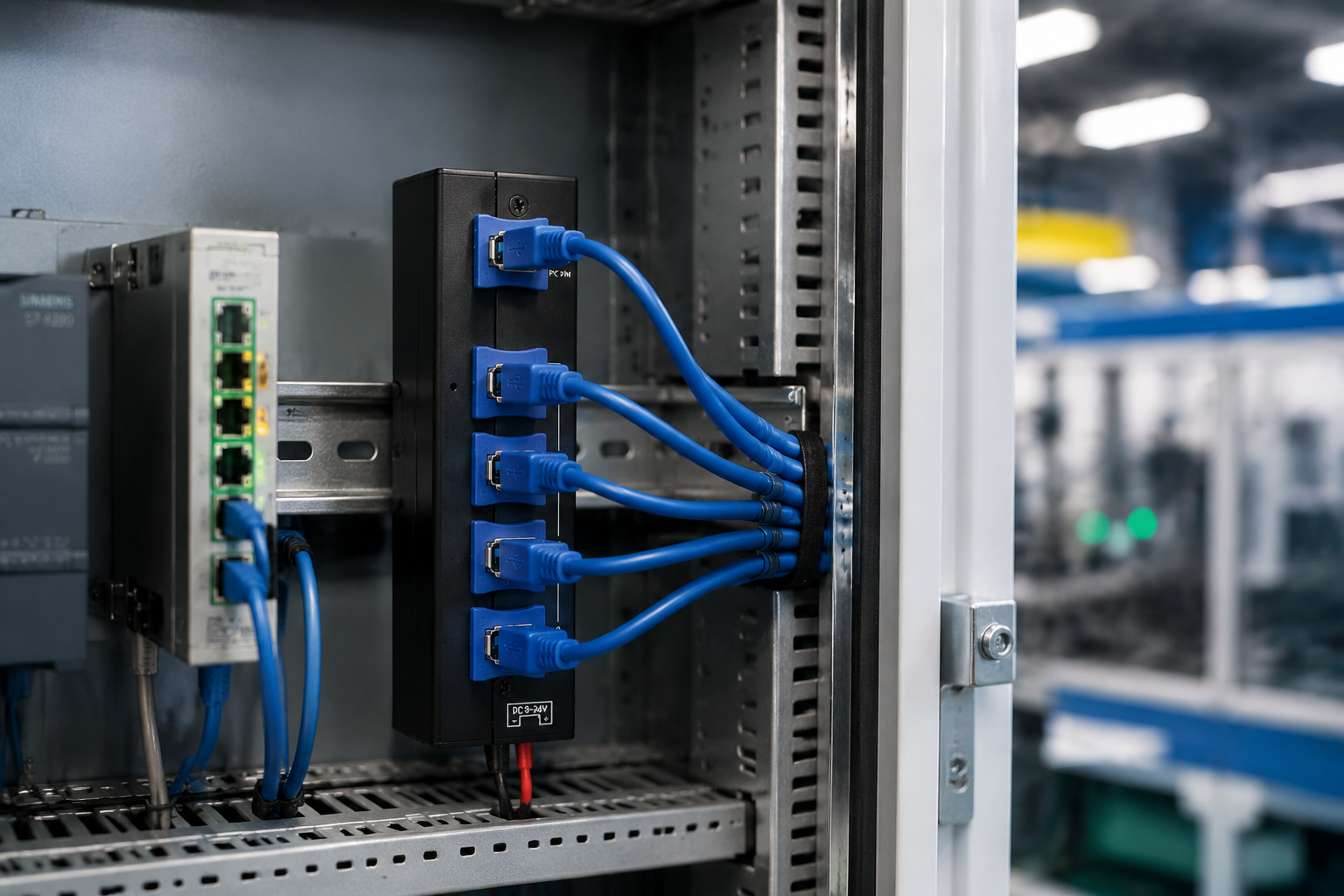
Mounting is also critical. Industrial hubs should offer DIN‑rail mounting (for control cabinets) or panel mounting with vibration‑damping washers.
Sipolar hubs feature rugged through‑hole construction and are available with DIN‑rail mounting accessories – keeping ports stable even on moving machinery.
Challenge #5: Dust, Humidity, and Corrosive Gases
The Problem
Industrial air is rarely clean. Common contaminants include:
Non‑conductive dust (wood, plastic, paper) – blocks cooling vents and insulates components, causing overheating.
Conductive dust (metal shavings, carbon) – can short circuit PCB traces.
High humidity – leads to condensation and corrosion.
Corrosive gases (sulfur, chlorine in some chemical plants) – attacks connector pins and solder joints.
The Solution: Environmental Sealing
The first line of defense is the Ingress Protection (IP) rating:
| IP rating | Protection against solids | Protection against liquids |
|---|---|---|
| IP40 | No dust protection (but >1mm objects) | None |
| IP54 | Limited dust ingress (not harmful) | Splashing water |
| IP65 | Dust‑tight | Low‑pressure water jets |
| IP67 | Dust‑tight | Temporary immersion (1m, 30 min) |
For most industrial environments, IP54 or IP65 is sufficient. For washdown areas (food processing), IP67 or IP69K may be required.
Additional measures:
Conformal coating – a thin polymer layer over the PCB that protects against humidity and mild corrosives.
Sealed USB ports with rubber covers when not in use.
Gold‑plated contacts (more corrosion‑resistant than tin plating).
Sipolar offers IP54‑rated hubs with conformal coating as an option – ideal for dusty workshops and high‑humidity labs.
Summary: Consumer vs. Industrial USB Hub Comparison
| Feature | Consumer Hub | Industrial Hub (Sipolar) |
|---|---|---|
| Temperature range | 0°C to 40°C | -40°C to +85°C |
| ESD protection | ±4kV air / ±2kV contact | ±15kV air / ±8kV contact |
| Enclosure | Plastic | Metal, shielded |
| EMI filtering | Basic or none | Ferrite beads, common‑mode chokes |
| Vibration resistance | Not specified | Through‑hole components, conformal coating |
| Mounting | Desktop only | DIN‑rail, panel, wall |
| Environmental sealing | None (IP40 typical) | IP54 / IP65 options |
| MTBF | Not published | >100,000 hours |
Real‑World Application Example
Scenario: A pharmaceutical packaging line uses USB barcode scanners at each station. The line runs 24/5, with ambient temperature reaching 45°C (113°F) inside control cabinets. Operators wearing ESD‑safe footwear still generate occasional static discharges.
Consumer hub outcome: Hubs failed every 3–6 months. Symptoms: intermittent scanner dropouts, corrupted scans, complete hub death after a static event. Each failure cost 2 hours of production downtime.
Industrial hub outcome (Sipolar): Hubs have run for 24+ months with zero failures. Wide‑temperature operation keeps them stable at 45°C. ESD protection survived multiple static events. Metal enclosure and shielded ports reject EMI from nearby motors.
Conclusion: Don’t Let the Environment Win
USB is a convenient and capable interface – but it was originally designed for office and consumer use. In industrial environments, you must choose hardware that is specifically engineered to handle heat, cold, static, noise, vibration, and dirt.
When evaluating USB hubs for factory, lab, or outdoor use, verify:
✅ Wide operating temperature (-40°C to +85°C)
✅ ESD protection (±15kV air / ±8kV contact)
✅ Metal, shielded enclosure
✅ Per‑port overcurrent protection
✅ Mounting options (DIN‑rail, panel)
✅ Optional conformal coating / IP rating
Sipolar’s industrial‑grade USB hubs are built to meet all of these requirements – and are backed by technical support that understands real‑world deployments.
Need a Hub for a Tough Environment?
Contact Sipolar’s engineering team. We’ll help you select the right model for your temperature range, EMI level, and mechanical constraints – and provide sample units for on‑site testing.